Castlefield Stock Story - ASML 2026
One of the most important names behind the rapid growth of artificial intelligence is not based in Silicon Valley, but in the Netherlands. ASML Holding NV (ASML) is possibly Europe’s most important technology company and is sometimes called the biggest company you’ve never heard of.
In this featured stock story, Castlefield Investment Analyst David Gorman introduces ASML, which is held in our TM Castlefield Thoughtful World Equity Fund.
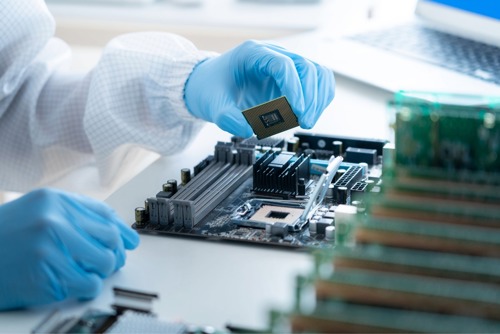
Based near Eindhoven, ASML was set up in 1984 and manufactures, sells and maintains the equipment used to produce advanced computer chips.
ASML is the world’s dominant supplier of semiconductor lithography systems, which use high-energy UV light to transfer or print microscopic circuit patterns onto silicon wafers. This process is critical to producing the semiconductors we use in smartphones, data centres, electric vehicles, medical devices, telecom networks and increasingly in AI.
The company’s most advanced systems use what is called extreme ultraviolet (EUV) lithography. ASML is currently the world’s sole commercial supplier of EUV lithography systems, giving it a unique position in the semiconductor equipment industry. EUV enables chipmakers to create smaller and more precise circuit patterns, allowing them to produce faster, more powerful and more energy-efficient semiconductors.
Modern semiconductors are tiny – a microchip the size of your fingernail contains billions of transistors, so it’s easy to understand just how small the features on a chip need to be. They are so small that they are measured in nanometres. A nanometre is one millionth of a millimetre. The most advanced microchips contain features that are just a few dozen nanometres in size. By comparison, the thickness of a human hair is 80,000 to 100,000 nanometres.[1]
The combination of technological complexity, R&D requirements, high equipment costs and demanding performance standards creates high barriers to entry and makes ASML’s market position exceptionally difficult to challenge.
ASML’s equipment is some of the most complex industrial machinery ever developed. The machines are huge – about the size of a bus and weighing up to 150 tonnes.[2] An EUV system can cost around $250m and incorporate components from a highly specialised global supply chain. The combination of technological complexity, R&D requirements, high equipment costs and demanding performance standards creates high barriers to entry and makes ASML’s market position exceptionally difficult to challenge.
ASML’s customers include the world’s leading semiconductor manufacturers, such as TSMC, Samsung and Intel. Why do chipmakers buy these machines? ASML sells the equipment that allows the leading chipmakers to keep pushing the boundaries of what semiconductors can do. Smaller chips improve performance while reducing the cost of each calculation, which is particularly important as demand for AI and high-performance computing continues to grow. EUV lithography can also simplify parts of the manufacturing process. In some production steps it reduces the need for repeated patterning, lowering complexity and helping customers improve yields.
ASML also earns revenue from servicing, maintaining and upgrading the systems already installed at customer sites. According to the company, almost 100%[3] of the lithography machines that it has ever sold since the founding of the company in 1984 are still in service, creating a valuable installed base and a recurring revenue stream.
Semiconductor manufacturing is resource-intensive and uses lots of energy, water and chemicals. ASML’s own operations and its broader customer base are therefore part of an industry with a significant environmental footprint.
There are, of course, sustainability considerations. Semiconductor manufacturing is resource-intensive and uses lots of energy, water and chemicals. ASML’s own operations and its broader customer base are therefore part of an industry with a significant environmental footprint. Along with the rest of the industry, ASML uses critical minerals such as tin, tantalum, tungsten and gold. Labour standards, health and safety and the use of third-party suppliers are areas for ongoing monitoring.
Set against these risks is the important role ASML can play in improving the energy efficiency of computing. As AI and data centres require ever greater processing power, the ability to produce more efficient chips becomes increasingly valuable. ASML’s technology supports the chip shrinkage and advanced manufacturing needed to make this possible.
The company occupies a rare position in one of the world’s most important growth industries. It enjoys a near-monopoly in EUV lithography, very high barriers to entry, deep relationships with the leading global chipmakers and valuable recurring service revenues from its installed base.
As the world asks more of its digital infrastructure, there is always pressure to make chips faster, smaller and more efficient. ASML is central to that story and remains one of the most strategically important companies in global technology.
Certain companies deserve particular attention because they provide the infrastructure on which wider economic progress depends. ASML is one of these companies. As the world asks more of its digital infrastructure, there is always pressure to make chips faster, smaller and more efficient. ASML is central to that story and remains one of the most strategically important companies in global technology.
Written by David Gorman
[1] https://www.asml.com/en/technology/all-about-microchips/microchip-basics
Information is correct as at 18.08.2026. Opinions constitute the fund manager’s judgement as of this date and are subject to change without warning. The officers, employees and agents of CIP may have positions in any securities mentioned herein. This material may not be distributed, published or reproduced in whole or in part. With investment, capital is at risk.